What You'll Need
Enclosure & Background
- 18x18x24 Front-opening Tank (Minimum)
- Cork Bark Panels or Foam Background
- Aquarium Safe Silicone (Black)
Substrate & Drainage
- LECA (Clay Balls) - 2-3 Liters
- Fiberglass Mesh Screen
- ABG Mix or Tropical Bioactive Substrate
- Leaf Litter (Oak/Magnolia)
- Sphagnum Moss (Dried)
Equipment & Life
- LED Grow Light (Full Spectrum)
- Misting System or Hand Sprayer
- Tropical Plants (Pothos, Ferns, Bromeliads)
- Cleanup Crew (Isopods & Springtails)
- Hygrometer/Thermometer
Step 1: Choose Your Enclosure
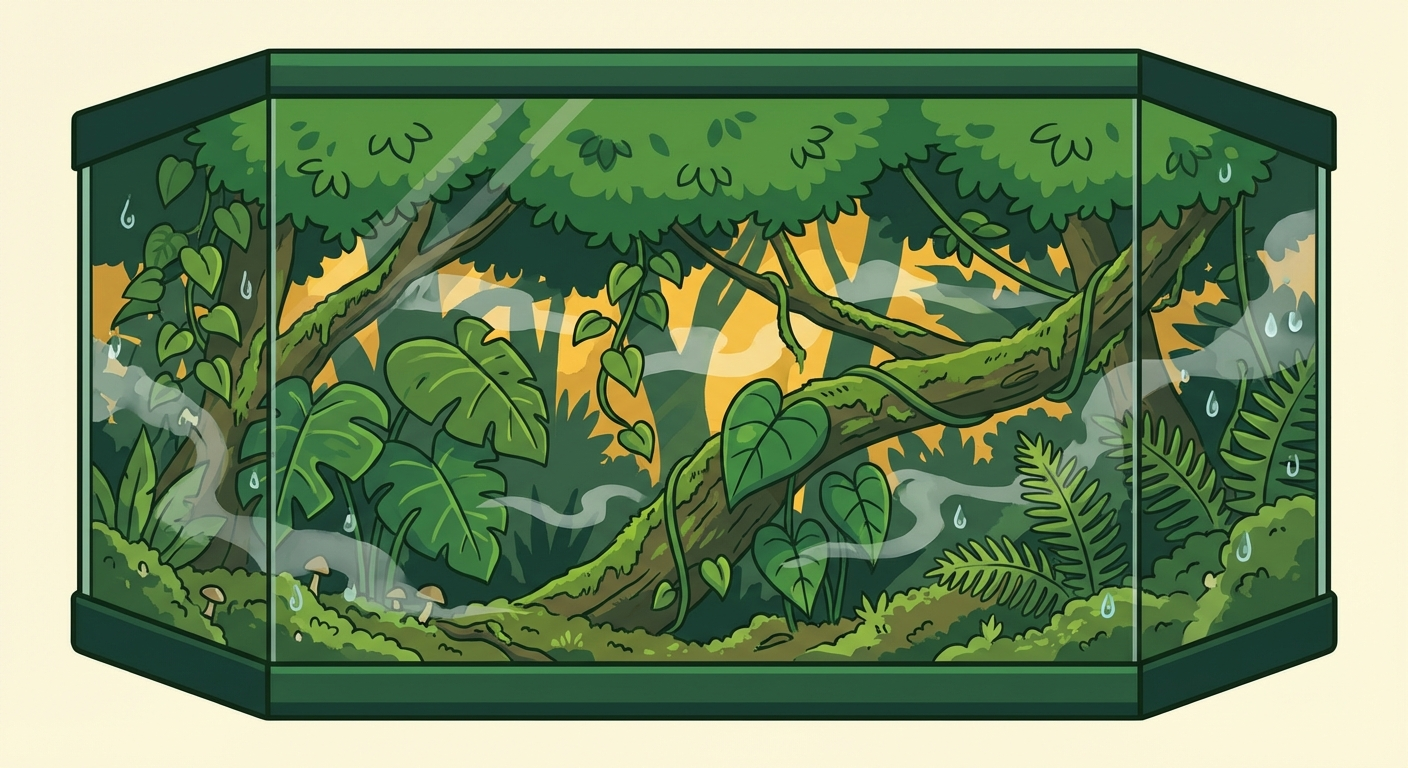
For a bioactive vivarium, the enclosure isn't just a box; it's a vessel for a high-humidity ecosystem. You need a tank that can handle moisture without leaking and allows for easy maintenance.
We strongly recommend front-opening glass terrariums (like the Exo Terra or Zoo Med 18x18x24). Why? Because when you are planting, misting, or catching isopods, reaching in from the top is clumsy. Front doors allow you to work face-to-face with your landscape.
Size matters. While you can go smaller, an 18x18x24 inch enclosure (roughly 20 gallons) is the sweet spot. It provides enough height for arboreal climbing, enough floor space for substrate depth, and enough volume to maintain stable humidity. If you go smaller, humidity spikes and drops become dangerous for sensitive amphibians like dart frogs.
Step 2: Install the Drainage Layer
This is the foundation of a healthy tropical setup. In a vivarium, you will water frequently. Without a place for that water to go, the soil becomes anaerobic (lacking oxygen), roots rot, and the tank smells like a swamp.
Add 1.5 to 2 inches of LECA (Lightweight Expanded Clay Aggregates) to the bottom of the tank. These porous clay balls sit under the soil, holding excess water while keeping the upper soil layer moist but not soggy.
Once the LECA is level, cut a piece of fiberglass mesh screen to fit the tank dimensions exactly. Place it directly on top of the LECA. This barrier keeps your expensive soil mix from washing down into the drainage layer. Ensure there are no gaps at the corners!
Step 3: Add Bioactive Substrate
Now we add the living earth. Do not use potting soil from a hardware store—it often contains fertilizers, perlite, and wetting agents that can kill your microfauna.
You want a specialized mix, often called ABG Mix (named after the Atlanta Botanical Garden). The "Gold Standard" recipe usually consists of:
- Tree Fern Fiber: Structure and longevity.
- Peat Moss: Moisture retention.
- Charcoal: Filtration (it keeps the soil sweet).
- Orchid Bark: Aeration for roots.
- Sphagnum Moss: Water holding capacity.
Add this mix to a depth of 2.5 to 3 inches. This depth is crucial. It needs to be deep enough to support plant roots and provide a thermal mass for the cleanup crew to burrow and reproduce safely.
Step 4: Create the Hardscape
The "bones" of your vivarium. This is where you create the vertical dimension. Since many vivarium inhabitants (tree frogs, geckos) are arboreal, you need to build highways in the air.
Start with the background. If using cork bark panels, silicone them to the back glass. Use plenty of silicone and tape them in place with masking tape while drying (24 hours).
Place cork rounds and ghost wood or manzanita branches. Arrange them to create visual interest using the "Rule of Thirds"—don't just put a stick in the middle. Angle branches diagonally. Ensure there are multiple pathways to get from the floor to the top of the tank.
Step 5: Install Lighting
Plants eat light. In a vivarium, the light is the engine of the ecosystem.
Skip the cheap aquarium hoods. You want a high-quality LED grow light. Look for a full spectrum daylight bulb (6500K color temperature). This mimics natural sunlight and keeps plants lush and compact.
If you are keeping reptiles, you need to consider UVB. For Crested Geckos, low-level UVB is beneficial. For Dart Frogs, it's not strictly necessary but won't hurt if it's low output (5.0). If you do add UVB, ensure the fixture is placed correctly—usually inside the tank or on top of a mesh screen (glass filters out 99% of UVB).
Set your lights on a timer for 10-12 hours a day. Consistency is key for plant health and animal circadian rhythms.
Step 6: Set Up Misting/Humidity
Tropical vivariums thrive in 70-90% humidity. You can achieve this by hand misting twice a day, but let's be honest—life gets busy.
A misting system (like MistKing) is the best upgrade you can make. It connects to a water pump and sprays a fine mist for 15-30 seconds, 2-4 times a day. This mimics rain and keeps the humidity perfect.
If you are hand misting, use a pressure sprayer (the kind for pest control, cleaned thoroughly) rather than a trigger spray bottle. It creates a finer droplet that doesn't soak the substrate as quickly.
Step 7: Plant It
This is the most rewarding step. Start with the background plants. Pothos and Philodendrons are bulletproof. Plant them in the substrate and train their vines up the cork bark.
Add Ferns (like Java Fern or Boston Fern) in the shadier corners. They love the humidity.
For the Bromeliads, these are epiphytes—they don't need soil. You can glue them or wedge them into the crooks of branches. Their central "cup" holds water, which is a favorite drinking spot for dart frogs and geckos.
Finally, cover the exposed soil with Sphagnum Moss. This acts as a humidity blanket, keeping the soil moist and preventing the cleanup crew from drying out.
Step 8: Add Your Cleanup Crew
The magic of a bioactive setup is that you don't have to clean poop. The bugs do it for you.
Isopods: These are the tank's janitors. Start with a culture of 20-30. Powder Blue Orange, Dwarf White, and Giant Canyon are excellent varieties. They eat decaying leaves, mold, and feces. They break it down into fertilizer for the plants.
Springtails: These tiny white arthropods live in the top layer of soil. They eat mold and organic waste. Add a generous amount—sprinkle the culture over the moss and leaf litter.
Step 9: Introduce Animals
Stop! Don't rush this. This is the most common point of failure.
You need to wait. Give the plants 2 to 4 weeks to root in and recover from transplant shock. Give the cleanup crew 2 weeks to establish a population. You should see springtails hopping on the glass and isopods roaming the leaves before you even think about adding a pet.
When you do add animals, acclimate them slowly. Open the bag and float it (if aquatic) or place it inside and let the temps equalize. Watch them for the first 48 hours. If they are hiding constantly, that's normal. If they are panting or trying to escape the glass frantically, your heat or humidity might be off.
Your First Week
The ecosystem is finding its balance. Here is what you might see and what to do about it:
- Mold Growth: You might see white or green fuzz on a piece of wood or an uneaten cricket. Do not panic. This is normal in a new bioactive setup. The springtails will find it and eat it within 24-48 hours. Only wipe it off if it spreads aggressively.
- Plant Wilting: Some plants might droop after planting. Keep the humidity high and the lights on. They usually bounce back once roots establish.
- Foggy Glass: If the glass is constantly dripping, your ventilation is too low or you are over-misting. Crack the top vents slightly to allow some airflow.
- Fruit Flies: If you are feeding dart frogs, you will escape flies. Keep a bottle of apple cider vinegar with a drop of dish soap near the tank to trap stragglers.
What's Next?
Your bioactive world is alive. Keep it thriving with these guides.